Capability Statement
For state revenue agencies evaluating census-based audit methodology.
- Company
- CensusAudit
- Business status
- US Navy veteran-owned small business
- Classification
- NAICS 541219 (Other Accounting Services) / 541511 (Custom Computer Programming Services)
- UEI / CAGE
- Registration in process. Both are provided on completion and in advance of any contract award.
- Website
- censusaudit.com
- Contact
- rory@censusaudit.com — Rory Rawlings, Founder
- Channel of record
- Email. Every enquiry is answered by the founder directly, in writing, so your file has a record you can forward, attach, or cite. There is no call centre and no sales queue in between. Telephone and video are available by arrangement once a conversation is underway.
- Mailing address
- Provided at contract execution.
- Accessibility
- This site and all delivered software target WCAG 2.1 Level AA and Section 508. See the accessibility statement.
Core capability
CensusAudit provides a census-based audit methodology — examining every transaction and every return line against the controlling statute, with the citation attached — that replaces the statistical sample-and-project method states use today for sales and use tax examinations. The engine reads the controlling statute, regulation, and court decision directly for every transaction line — not by mapping to a harmonized tax code. The calculation is deterministic: same product, same statute, same answer, every time.
What we do
Ingest taxpayer extracts
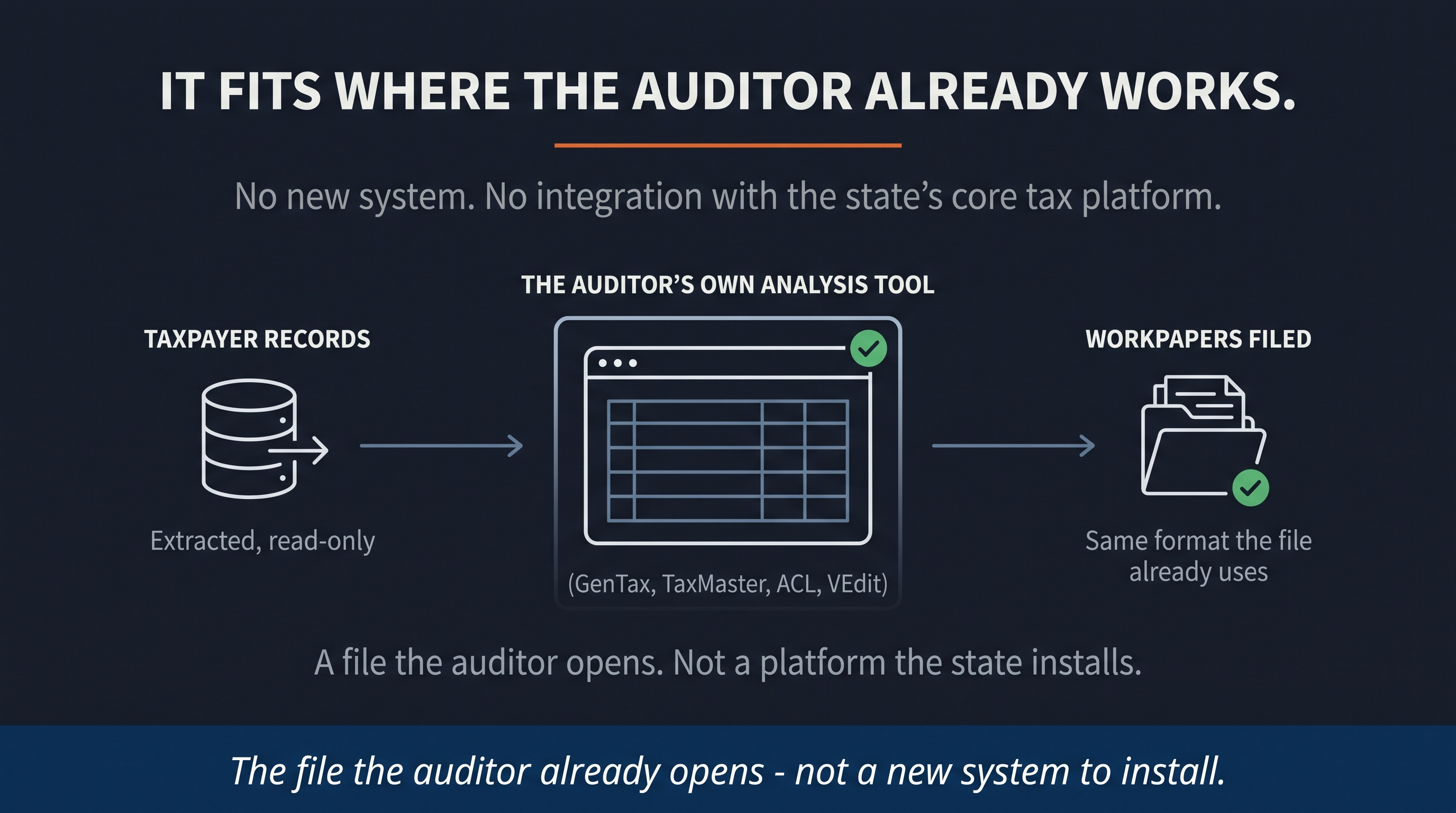
Flat file, CSV, Excel — the e-audit formats your state already requests. General ledger, sales journals, purchase detail, exemption certificates. No new collection process required.
Validate every exemption certificate
Every exemption certificate is extracted and validated: permit number active at time of sale, buyer name matches registration, certificate not expired, signature present, exemption type matches the transaction. Handwritten forms, scanned PDFs, digital submissions — the system reads and validates every field. Every certificate is either confirmed or flagged with the specific deficiency.
Census determination
With jurisdiction resolved to the parcel and statute applied at the line level, every transaction receives a deterministic taxability determination with the controlling citation attached. Nothing projected, nothing extrapolated — every line stands on its own.
Auditor workpaper export
Output into the formats your auditors already file into GenTax/TaxMaster — whatever case-management system your state runs.
Sampling comparison
Run your state’s own sample method beside the census on identical data. The delta is the honest measure of whether the methodology matters — and it is the only test we would ask you to judge us on.
Also: parcel boundary data
In addition to audit services, CensusAudit provides parcel-accurate jurisdiction boundary tables — the same data produced by patent-pending Cadastral Situs Resolution. Every cadastral parcel polygon tested against every jurisdiction boundary polygon, producing a deterministic in/out/bisected answer for every address in the state.
These tables can be licensed by state revenue agencies to improve their own jurisdiction assignment, or by sales tax providers to replace ZIP-code-based approximation with parcel-level accuracy.
Differentiators
| Incumbent approach | CensusAudit |
|---|---|
| Statistical sample (75–80% confidence) | Census of every transaction |
| Error rate projected across the period | Nothing to project — every line stands on its own |
| Auditor defends the sample method | Auditor cites the statute — line by line |
| Sample methodology appealable (Gatta, NJ 2018) | No sample to project, so the Gatta failure mode cannot occur |
| Requires GenTax/TaxMaster integration | Reads the extract; exports workpapers. No integration needed. |
Data governance
Data isolation
CensusAudit maintains no shared customer data with any commercial determination platform. No seller’s transaction data can reach a state through a related entity. The separation is structural, not aspirational — separate databases, separate access controls, separate retention policies. Stated publicly so every seller and every state can verify it independently.
Data handling
Taxpayer extracts are processed in isolated environments. Data is encrypted in transit and at rest. Extracts are retained only for the duration of the engagement and purged upon completion. Access is logged and limited to the personnel performing the analysis. We will execute your state’s data protection agreement and comply with your state’s equivalent of IRC 6103 confidentiality requirements.
Provenance — two patents, spanning two decades
Rory Rawlings is the original architect of the first automated sales-tax determination platform, AvaTax. He founded and architected the platform, wrote the taxability-content codes that still ship with the category-leading product, and understands firsthand where every approximation in that architecture lives.
2005 — the best approximation available
In 2005, Mr. Rawlings filed U.S. Patent Application US20070136158A1, “Accurate tax calculation” — the patent that became AvaTax. The best available method at the time was point-in-polygon: a single coordinate dropped into a ZIP code and tested against a jurisdiction boundary. It resolved the address to a ZIP code, not to the parcel. It classified the product by mapping to a harmonized tax code, not by reading the statute. It was the right trade for the time — the computational cost of doing better exceeded the accuracy budget.
That architecture, for all its approximations, automated what had been a manual process and was adopted by roughly half of the Fortune 500. But every approximation — every ZIP-code centroid, every harmonized-code mapping — was a bet that the error landed inside the audit tolerance. When it did not, the assessment fell on appeal. Gatta v. Director, New Jersey Tax Court, 2018 — a sample assessment invalidated because small per-item errors propagated across the audit period.
2026 — deterministic statute-bound determination
Two decades after the first patent, the same inventor filed U.S. Provisional 64/097,002 — the patent-pending successor. Two inventions replace every approximation with deterministic accuracy.
The first is Cadastral Situs Resolution: every address resolved to the actual cadastral parcel, the parcel polygon tested against the jurisdiction boundary polygon — in, out, or bisected, with each jurisdiction’s own rule for split parcels applied. No point. No guess. The result is the correct jurisdiction, parcel by parcel.
The second is Deterministic Statute-Bound Tax Determination that reads the controlling statute, regulation, and court decision directly — producing the same taxability answer for the same product and the same law, every time, with the citation attached. A three-stage pipeline (exact-hash cache, vector-similarity match, label-clustering with margin guardrail) turns a non-deterministic language model into a deterministic classifier.
Together, these two capabilities make a census audit practical: when both jurisdiction and taxability are deterministic, there is nothing to sample and nothing to project. Every transaction line receives a statute-cited determination that is reproducible on demand — on the auditor’s screen, on the taxpayer’s appeal, and on the witness stand.
What that means for a state audit
The 2005 invention automated tax calculation. It replaced manual lookups with a machine-readable rate table and a harmonized code map — and it was the right answer for its time. But calculation is not determination. A rate table tells you what to charge; it does not tell you whether the law requires you to charge it.
The 2026 invention automates tax determination. It reads the statute itself, not a code derived from it. It resolves the transaction to the actual parcel, not a ZIP code centroid. And it produces a defensible, reproducible answer for every line — which is what an audit requires, what an appeal tests, and what no technology before this one could deliver.
Patent pending. US Navy veteran. From the inventor of AvaTax.
Start with a pilot, scoped to your own process
A first engagement can be sized to fit your agency’s existing small-purchase authority, or run as a full competitive procurement — whichever your rules require. We follow your process; we do not ask you to work around it.
Discuss a pilot