Accurate Audit
Every incumbent audit tool helps an auditor sample better. This removes the need to sample — by examining every transaction, validating every exemption certificate, and determining product taxability from the controlling statute.
US Navy veteran-owned. Patent pending.
What an auditor actually checks
A state sales tax audit has three pillars. Every one of them is a question the auditor must answer for every taxpayer, every period.
1. Sales verification
Do total reported sales match what was actually sold into the state? The auditor compares the taxpayer’s general ledger, sales journals, and filed returns — looking for unreported revenue, misclassified transactions, and sales into jurisdictions where the taxpayer may not have filed.
2. Exemption justification
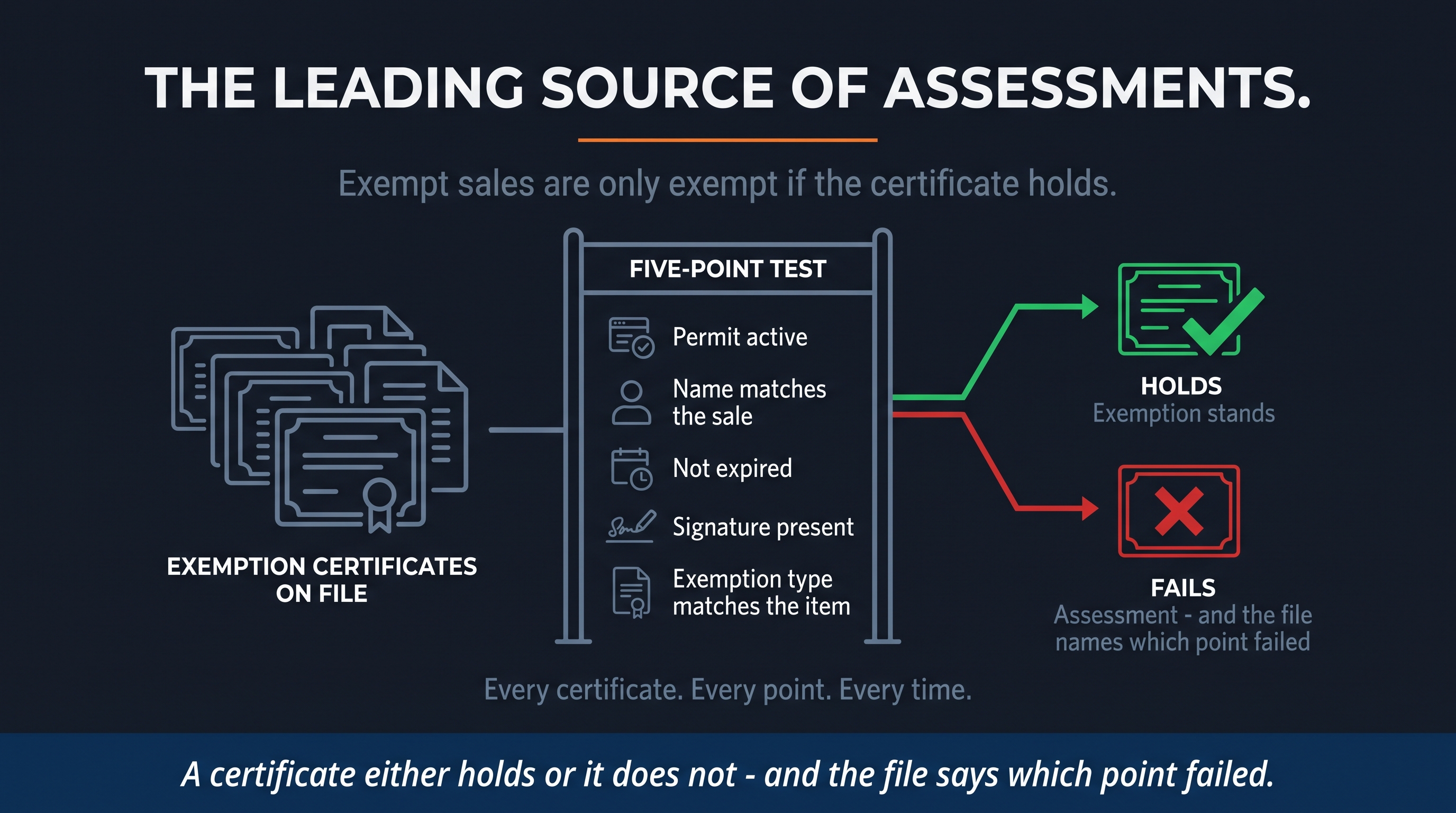
For every sale where tax was not collected, is there a valid exemption certificate on file? The burden of proof is on the seller. Without a valid certificate — properly completed, signed, with an active permit number, and matching the transaction — the seller is liable for the uncollected tax, plus penalties and interest.
3. Tax reconciliation
Does the tax collected from customers equal the tax remitted to the state? The auditor compares point-of-sale records, general ledger tax accounts, and filed returns — identifying under-collection, over-collection, and remittance gaps. A single missing certificate projected across a sample period can generate a six-figure assessment.
What a transaction actually needs
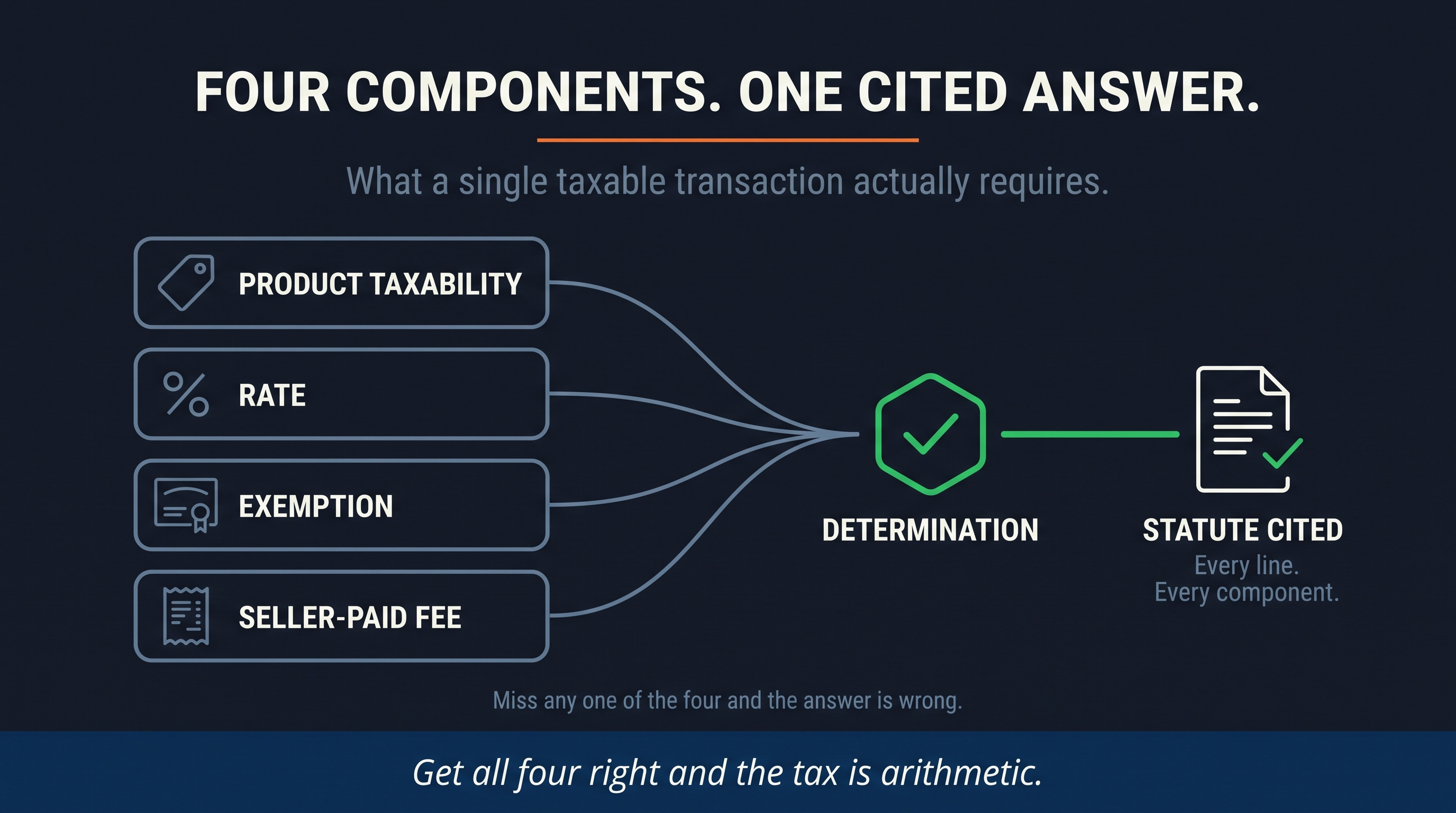
A correct sales tax determination has four components. Get all four right and the calculation is arithmetic.
Product taxability
Is this product taxable or exempt in this jurisdiction? Under which statute? CensusAudit reads the controlling statute, regulation, and court decision directly — rather than mapping to a harmonized tax code — and produces a deterministic, statute-cited classification. The same product and the same law always yield the same answer.
Rate
Which jurisdiction’s rate applies at this address? Your state already owns this data — street segments, ZIP+4 tables, whatever boundary tables your auditors use today. CensusAudit uses your jurisdiction data to apply your rates. Your safe harbor, your rules. Nothing to replace, nothing to dispute.
Exemption reason and certificate
If the transaction is exempt — for resale, for a nonprofit, for manufacturing, for agriculture — which exemption applies? Is the certificate valid? CensusAudit reads and validates exemption certificates directly: permit number active at time of sale, buyer name matches registration, certificate not expired, signature present, exemption type matches the transaction. Handwritten forms, scanned PDFs, digital submissions — the system extracts and validates every field.
Fees and seller-paid excise taxes
Some taxes are paid by the seller, not collected from the customer — excise taxes, gross receipts taxes, environmental fees, 911 surcharges. These are part of the audit too. The calculation covers every tax obligation the seller owes to the jurisdiction, whether or not it appears on the customer’s invoice.
Product × Rate × Exemption = Tax. When all four components are correct — and the statute citation is attached to every determination — the calculation is arithmetic, and the audit finding is defensible on appeal.
How the determination works
The state supplies the data it already collects
Taxpayer extracts in the formats your state already requests in an e-audit: flat file, CSV, Excel. General ledger detail, sales and purchase journals, exemption certificates — including handwritten and scanned forms. No new collection process — your Computer Audit Specialist already works with this data in ACL or VEdit. We read it directly.
Every exemption certificate is read and validated
The system extracts every field from every certificate — buyer name and address, permit number, exemption reason, signature, date — and validates each against the state’s records. Permit active at time of sale? Name matches registration? Certificate not expired? Exemption type matches the transaction? A handwritten form is read with the same rigor as a digital submission. Every certificate is either validated or flagged with the specific deficiency — missing permit, expired, unsigned, wrong exemption type, wrong state.
Product taxability — from the law, not a code
For every product on every transaction line, the system reads the controlling statute, regulation, and court decision directly — rather than mapping to a harmonized tax code. A generative language model performs the classification, and the patent-pending three-stage deterministic pipeline — exact-hash cache, vector-similarity semantic match, and label clustering with a margin guardrail — ensures the same product and the same law always yield the same answer. Deterministic. Reproducible. The citation is attached to every determination.
Jurisdiction — your data, your safe harbor
Your state’s jurisdiction assignment data — street segments, ZIP+4 tables, whatever you use — is the safe harbor. CensusAudit applies your state’s own jurisdiction rules and rates to every transaction. No new boundary data, no dispute over which jurisdiction governs. Your auditors defend their own jurisdiction assignments; CensusAudit ensures the taxability determination, exemption validation, and calculation are correct within them.
Sampling comparison — the honest self-test
Run your state’s own sample method beside the census on the same data and see the delta. Every transaction examined, every certificate validated, every determination cited. If the census does not beat the sample on a real dataset, we should know first — and so should you. It is the only honest way to evaluate a change in methodology.
Audit sample vs Census Audit
| Statistical Sample | Census Audit |
|---|---|
| Examines a subset, projects the error rate | Examines every transaction |
| Taxability determined by auditor judgment | Taxability determined from the statute, with citation |
| Exemption certificates spot-checked by hand | Every certificate read, extracted, and validated |
| Same product may get different treatment across auditors | Same product, same law — same answer, every time |
| Gatta v. Director (NJ, 2018) — sample invalidated | No sample to project, so the Gatta failure mode cannot occur |
Why it’s defensible
“The small per-item errors that occurred in certain sample period months were then propagated from a sample period to the entire audit period.”
New Jersey Tax Court, Gatta v. Director, Div. of Taxation (Dec. 14, 2018) — invalidating a sales-tax sample assessment.When every transaction is examined, every certificate is validated, every product is classified from the statute, and every determination carries a citation — there is no projection error to appeal. A census removes every variable the court identified.
See a census run on your data
The fastest way to evaluate this is a direct comparison. We run a census beside your state’s own sample method on the same data and show you the delta.
Request a comparison