Every transaction. Not a sample.
A statistical sample examines a fraction of a taxpayer’s transactions and projects the result across the whole audit period. A census examines every one. CensusAudit examines every transaction and every return line against the controlling statute, and attaches the citation to each determination — so there is nothing projected, and nothing to appeal but the law itself.
Patent pending.
A census examines the entire population of transactions — not a subset, not a projection, not an estimate. It was impractical for as long as the computational cost of examining every line exceeded the audit budget, so the industry settled for statistical sampling. Every state sampling manual reviewed targets a 75–80% confidence level: Tennessee’s own brochure requires just 75% confidence “that the taxpayer owes at least as much as is being assessed,” and California’s audit manual sets 80%. A census audit has always been what the auditor wanted. It has not, until now, been what the technology could deliver.
“Small per-item errors propagated from a sample period to the entire audit period” — and the assessment fell.
New Jersey Tax Court, Gatta v. Director, Div. of Taxation (Dec. 14, 2018) — invalidating a sales-tax sample assessment.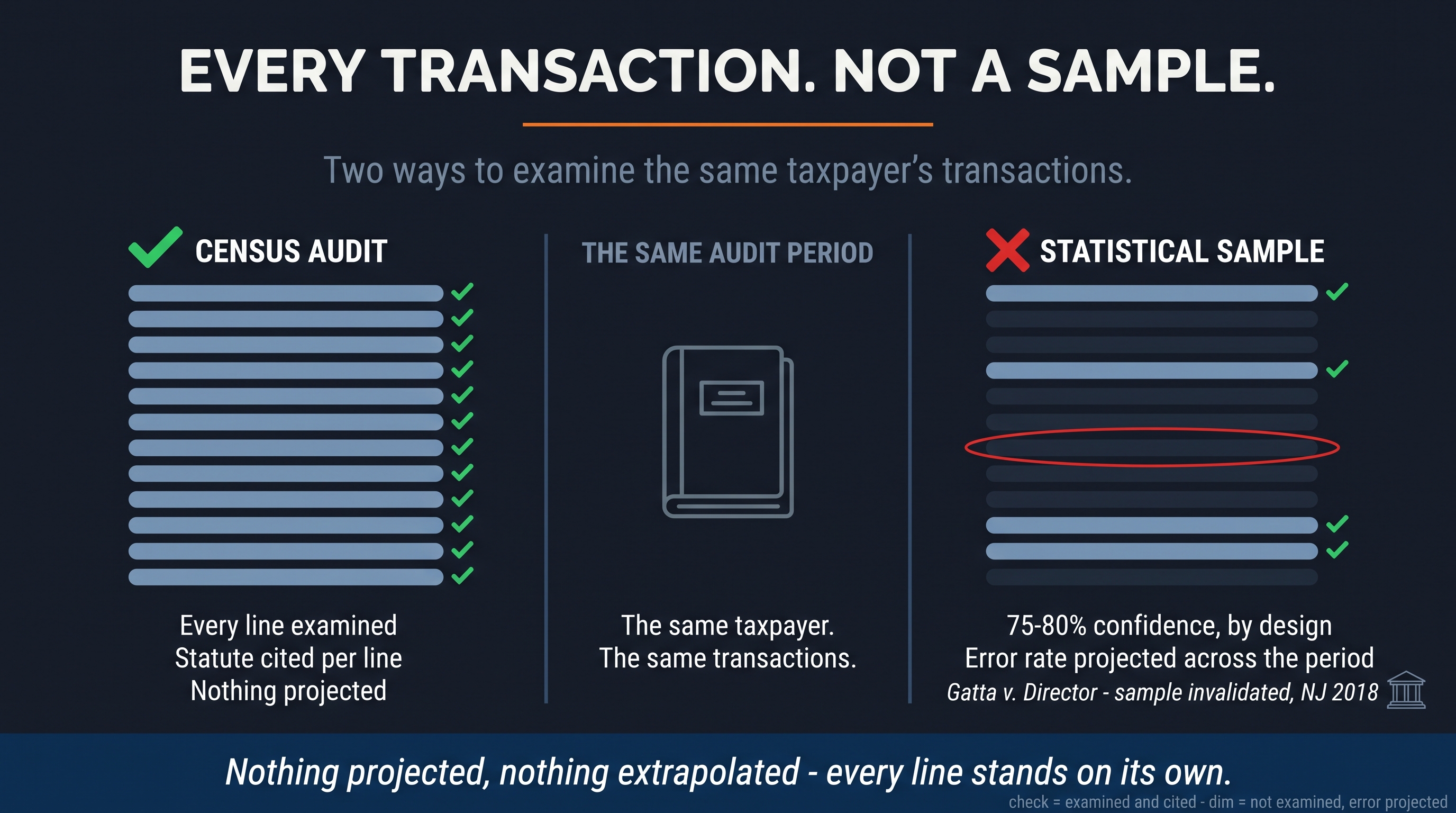
Deterministic Statute-Bound Tax Determination
The patent-pending invention, in its own words. Deterministic, statute-bound taxability — the same product, the same statute, the same answer, every time.
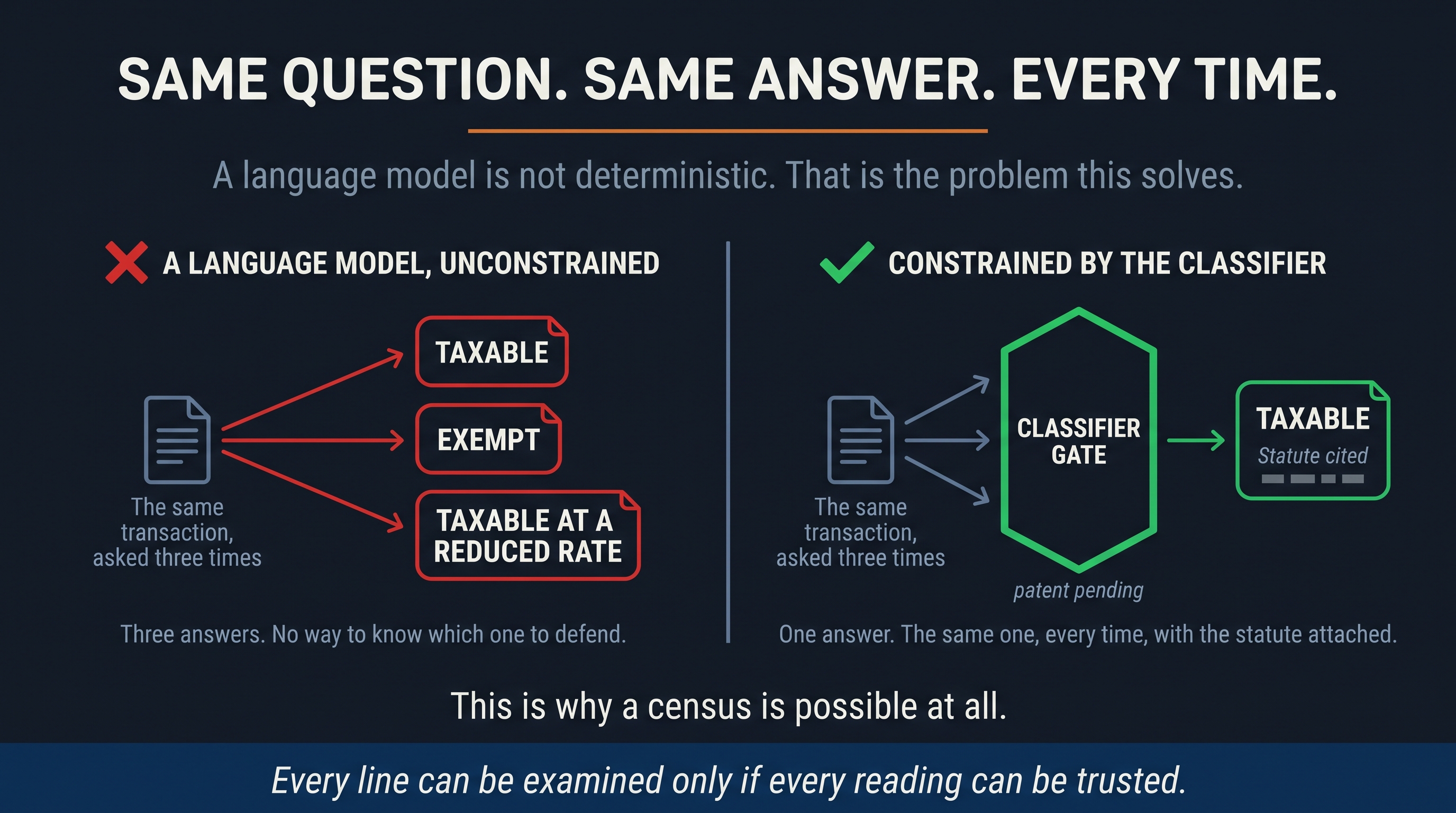
A large language model can read a statute and classify a product. But it cannot guarantee it will give the same answer tomorrow. Floating-point accumulation order, mixture-of-experts routing, speculative decoding — the same input can produce different output. For an audit, that is fatal. A determination that changes between invocations cannot be defended on appeal.
The patent-pending invention is a three-stage deterministic pipeline that sits between the language model and the database. Stage one: an exact-hash lookup against a classification cache — if the product has been classified before, the stored answer is returned without invoking the model. Stage two: a vector-similarity semantic match against historical classifications. Stage three: a label-clustering algorithm with a margin guardrail that permits a new classification only when it is unambiguously closer to one canonical label than any other. The result: a non-deterministic language model produces deterministic, reproducible, database-foreign-key-stable output. Same product, same statute, same answer — every time.
Deterministic classification is what makes a census practical. Without it, every transaction must be sampled — because the auditor cannot defend a finding that might change on the next run. With it, every transaction line receives a statute-cited determination that is reproducible on demand. That is the difference between a sample and a census.
Three products, one engine
Accurate Audit
Deterministic Statute-Bound Tax Determination applied to state audit. Ingest taxpayer extracts in the formats your state already collects. Validate every exemption certificate — handwritten, scanned, or digital. Determine product taxability from the controlling statute with the citation attached. Compare census results against your state’s own sampling method on identical data.
Boundaries
Parcel-accurate jurisdiction boundary tables — the same data produced by patent-pending Cadastral Situs Resolution. Every cadastral parcel tested against every jurisdiction boundary polygon. For states that want to upgrade their jurisdiction assignment, and for sales tax providers that want parcel-level accuracy under their existing API.
IQ
A voice agent that knows your state’s tax law — provisioned with your statutes, regulations, rulings, forms, and publications. Answers taxpayer questions by phone or on the web with the same deterministic engine that powers the audit. Not a general-purpose chatbot improvising from internet training data.
What a state gets
- For state revenue agencies
- Ingest the electronic records your auditors already request — general ledger, sales journals, exemption certificates. Every product on every line is classified against the controlling statute, regulation, and court decision. Every exemption certificate is read and validated: permit active at time of sale, name matches, not expired, signature present, exemption type matches the transaction. Every determination carries the citation. Every result is exported into the workpapers your auditors already file into GenTax, TaxMaster, or whatever case-management system your state runs.
- Defensibility
- An auditor is never asked which sample they drew. They are asked what the law says. That is the question a census answers — line by line, on the record, with the citation attached. And because the determination is deterministic and reproducible, the same product and the same statute always produce the same answer — on the auditor’s screen, on the taxpayer’s appeal, and on the witness stand.
- Why now
- State sampling manuals target a 75–80% confidence level — Tennessee requires just 75% confidence “that the taxpayer owes at least as much as is being assessed,” and California’s audit manual sets 80% with allowable precision of up to 75%. Assessments then evaporate on appeal: 40–49% of assessed dollars were cut in Connecticut’s four-year sample. Auditor vacancy rates run 11–16% and rising. What has changed is that a determination can now be made reproducibly, line by line, at the scale a census requires.
- Provenance
- Founded by Rory Rawlings, US Navy veteran and the inventor of AvaTax. The patent-pending Deterministic Statute-Bound Tax Determination was invented by the founder, filed under U.S. patent application 64/097,002, and first deployed in the commercial determination platform. CensusAudit applies that invention to the state-audit side.
- Status
- Active. If you administer tax for a state and want to see a census run beside your own sampling method on the same data, that conversation is open now — rory@censusaudit.com.
One conversation
If you administer tax for a state, the fastest way to evaluate this is to run a census beside your own sample on the same data. The delta tells you whether it matters — in 30 minutes.
Start the conversation